




For many organisations, one of the biggest procurement decisions is the purchase of gas and electricity. The trusted strategies that worked in the past are no longer fit for purpose in today’s more volatile energy market. Some misconceptions remain and can harm your chances of getting the best possible contract.
This guide from Sustainable Energy First’s procurement team explains how energy and gas markets really work, so you can come up with the best strategy for your organisation.
Electricity and gas are traded commodities
Both electricity and gas are commodities traded on the open market. Suppliers buy electricity from generators on the wholesale market before selling it on to their customers. The wholesale price of both gas and electricity changes multiple times a day, based on factors including:
- How much renewable energy is being generated
- Gas pipeline flows
- Fluctuating demand levels
- Global politics
Electricity and gas are commodities – but commodity cost is only part of the story
The actual energy is only part of the bill
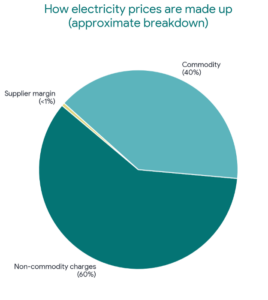
The market cost of the electricity or gas you use is just one element of your energy bills. There are two other significant elements:
- Supplier margins
- Non-commodity costs
The supplier margin is what your energy supplier adds to cover their own costs and make a profit. It’s typically less than 1% of the total bill.
Non-commodity costs are a much bigger chunk of your bill – around 60%. They’re imposed by the government to cover the costs of running the grid and supporting new renewable generation. Your supplier doesn’t get any money from these charges but it’s obliged by law to bill you for them and pass the funds on. Our guide to non-commodity charges explains more.

Fixed-price energy contracts are poor value
Fixed-price contracts are the traditional way for many organisations, public and private sector, to procure their gas and electricity. For smaller purchasers this was the only way to access utility pricing. Unfortunately, many of these contracts are negotiated at the wrong time, which means the organisation is stuck with a per-unit price that isn’t competitive across the whole period. The supplier will also build in a risk premium, pushing the price up further.
Group buying gives you access to the wholesale market…
This is where group (also known as portfolio/basket/consortium) procurement methods bring savings. For smaller purchasers who could not ordinarily access the wholesale market directly these arrangements open access to trading commodities themselves, alongside similar organisations.
Generally to gain access to trade commodities on the wholesale market will only require 8-10 organisations purchasing together.
…But group buying doesn’t reduce the cost of energy itself
While group buying can improve access to the wholesale market, it does not reduce the unit price of energy. The per-unit price on the wholesale market is the same for every customer buying energy at that moment, whether they’re buying 1 MWh or 100MWh. Don’t believe any broker claims that group tendering can secure a lower price for the energy itself.
Bulk buying also does nothing to reduce the non-commodity charges on your bill.
The only element of your bill that could potentially be reduced by bulk buying is the supplier margin. If you sign your energy contract as part of a group, the economies of scale could allow your supplier to reduce their mark-up. But this doesn’t represent a big saving (as explained, the supplier margin is typically less than 1% of the overall bill).
Don’t believe any broker claims that group tendering can secure a lower price for the energy itself
Today’s energy markets are volatile
To make the best buying decisions on the wholesale market it’s important to understand what’s happening with those markets.
Today’s UK electricity markets are drastically different and much more volatile than in the past.
Many traders used to operate a calendar-based procurement strategy. This is where the parties agree to trade a certain percentage of the volume by specific dates. Spreading the trades over a longer period means paying a price closer to the overall average for that period. It worked well in the more stable energy markets of the past, but it’s risky in today’s changeable environment.
The 2018 ‘Beast from the East’ was the first real shock for many, when freezing weather saw per-unit prices shoot up to 5.94p/kWh. This was further compounded by the Russia Ukraine war which saw markets peak at 72.22p/kWh.
2010-2018 | 2018-now |
Stable market | Highly volatile market |
Prices between 3.34p and 5.94p per kWh | We’ve seen lows of 3.23p and highs of 72.22p per kWh |
Calendar-based procurement made sense, averaging the market would achieve ~40p per kWh | Calendar-based procurement is poor value, many trading bodies have already moved away from it. |
In today’s volatile market, timing is key. Your energy broker should use their knowledge of the market and your organisation’s risk profile to purchase at the best possible time for you.
Alternatives to wholesale
Where price stability and renewables credentials are the most important factors, sometimes long-term Power Purchase Agreements can be beneficial alternatives and group options to access this market also exist.
Choosing a broker for energy procurement
The scale of a group purchasing portfolio won’t determine whether they can drive the best value utility costs. When selecting an energy broker, the focus should be on whether the broker is the right partner to secure the best deal for your organisation.
As we’ve explained, there is no such thing as a bulk-buying discount for energy. What matters far more is the quality, transparency, and suitability of the broker’s approach.
The key questions to ask are:
- What strategy will the broker use to get the best possible price for your organisation?
- How does this strategy reflect your budget and appetite for risk?
- How does it compare to the strategies from other brokers?
- How much is the broker charging for their services?
- Will your organisation get a transparent breakdown of costs?
- Will you see the details of the gas and electricity contracts being signed on your behalf?
- Will the suppliers chosen align with your organisation’s values and with your net zero goals?
Sustainable Energy First is the energy procurement partner for a range of diverse organisations in the public and private sectors. We are happy to supply the answers you need to make an informed decision. For more information, get in touch via the form below.