



The Science Based Targets initiative (SBTi) has published Version 2.0 of its Corporate Net-Zero Standard, introducing the most significant changes to the framework since its launch in 2021.
Aimed at making science-based climate action more practical and credible, the updated standard places greater emphasis on implementation, transition planning, and measurable progress, while introducing a more flexible approach to some of the biggest challenges businesses face on the road to net zero.
If your organisation already has science-based targets, or is considering setting them, here’s what you need to know. For a more in-depth look at the SBTi, check out our full explainer.
Greater flexibility for businesses across markets
One of the most notable updates is a more flexible approach to target setting, with companies differentiated into Category A and Category B based primarily on organisational size, turnover, and the economic classification of the country in which the organisation operates (high- versus lower-income countries).
The SBTi has acknowledged that organisations face different challenges depending on their size, sector, and value chains. Version 2.0 introduces greater flexibility in how businesses can meet the standard, while maintaining scientific integrity and alignment with global goals.
The intention is to make the framework more practical and accessible, particularly for organisations that found some elements of the previous standard difficult to implement.
Scope 3 emissions remain a priority
Scope 3 emissions remain a major focus within the updated standard. While companies are still expected to significantly reduce value chain emissions over the long term, Version 2.0 provides greater flexibility in how progress can be demonstrated, including through supplier engagement, sustainable procurement and other value chain interventions.
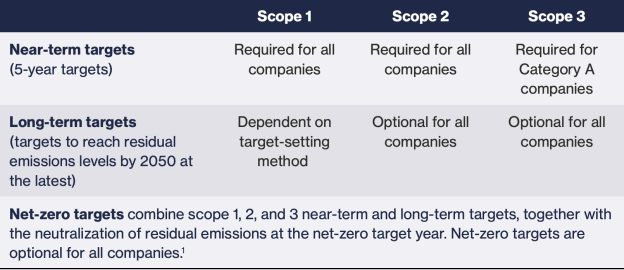
Image from SBTi Foreword and Executive Summary
Given that Scope 3 emissions often account for the largest share of an organisation’s footprint, the SBTi says this approach will help companies focus on the areas where they can have the biggest impact.
Other key changes to the standard
Beyond Scope 3 emissions, Version 2.0 introduces several wider changes designed to make net zero implementation more practical. Businesses will be expected to set more targeted, context-specific emissions-reduction goals that reflect their operations, supply chains and sectors, while strengthening the connection between target setting and credible transition planning.
The revised standard also places greater emphasis on transparency, requiring organisations to report openly on their progress, assumptions and any barriers that could affect delivery. Companies are expected to demonstrate they have used every available lever to reduce emissions before relying on market-based mechanisms.
While high-integrity carbon credits and other climate contributions still have a role to play, the SBTi makes clear they should complement, rather than replace, direct emissions reductions.
What does this mean for business?
For organisations already working towards science-based targets, Version 2.0 is an opportunity to review existing climate strategies and ensure they remain aligned with evolving best practice.
Businesses should begin considering whether their current transition plans, governance arrangements and emissions data are robust enough to meet new expectations as the updated standard is introduced.
Companies currently validated under the existing standard will have transition arrangements in place, with Version 2.0 expected to become the basis for future target validation from 2027.
Event | Date |
Corporate Net-Zero Standard V 2.0 is published | 11 June 2026 |
SBTi releases further validation resources for V 2.0 | 1 October 2026 |
Validations for Corporate Net-Zero Standard V 2.0 open | 1 February 2027 |
Validations for Corporate Net-Zero Standard V 1.3.1 close | 31 January 2028 |
Corporate Net-Zero Standard V 2.0 becomes mandatory for all submitting companies | 1 February 2028 |
Looking ahead
As sustainability reporting continues to evolve, businesses are facing increasing pressure to move beyond ambitious commitments and demonstrate measurable progress towards net zero.
The SBTi’s updated Corporate Net-Zero Standard reflects this wider shift, encouraging organisations to integrate climate action into everyday business decision-making rather than treating it as a standalone reporting exercise.
If you’d like advice on developing a credible net zero strategy or aligning your organisation with the latest climate frameworks, get in touch with our experts at Sustainable Energy First for a no-obligation chat.