
Streamlined Energy and Carbon Reporting (SECR) is a mandatory scheme that requires certain businesses to collect information relating to their energy use and associated carbon emissions. They must then share this information as part of their annual reporting to Companies House. SECR applies to listed businesses and those over a certain size.
SECR came into force on 1st April 2019.
SECR applies to three different types of companies:
- Companies listed on a stock exchange (“quoted companies”)
- Companies that aren’t listed on a stock exchange but meet the Companies Act definition of “large”
- Limited Liability Partnerships (LLPs) that meet the definition of “large”.
The Companies Act 2006 defines large companies as those that meet at least two of the three following criteria:
- Turnover of £36 million or more;
- A balance sheet total of £18 million or more;
- 250 employees or more.
SECR asks organisations to report on their energy use and the greenhouse gas emissions arising from that energy use.
The rules vary depending on the type of company. The biggest difference is that quoted companies have to calculate and report all greenhouse gas emissions the company is responsible for, globally. They must also report all the underlying energy use that was used to calculate the figure for GHG emissions. (Jump to the last question in this FAQ for more detail on the differences).
Large unquoted companies and LLPs just have to report on their UK energy use and associated emissions.
All types of business must also include:
- The previous year’s figures for greenhouse gas emissions and energy use.
- At least one intensity ratio (showing their emissions in the context of another metric, such as tonnes of CO2e per thousand products manufactured).
- What action they are taking to become more energy efficient.
- The methodology used to do the calculations for the report.
It has been a few years since the government updated the official numbers, so it isn’t possible to be completely accurate on this one. According to the information we have, around 11,900 businesses meet the SECR criteria by being listed or sufficiently large. When you remove the exempt businesses it’s around 11,300.
SECR reporting is done as part of your annual returns to Companies House, so it is aligned with your company’s financial year (which may be different from the UK tax year). It will be due when your next annual report is due.
SECR reporting is done as part of your annual returns to Companies House, so it is aligned with your company’s financial year (which may be different from the UK tax year). It will be due when your next annual report is due.
No. Organisations are encouraged to align all information with financial years, “to aid comparability and consistency of information across reports and organisations”, but it is not compulsory.
If the annual period your organisation chooses for its SECR reporting is not the same as its financial year, you should make this fact clear in the report.
The obligation under SECR is to disclose annual figures for emissions and energy use, so your SECR reporting period should still be 12 months.
For businesses with an 18-month financial year it is good practice, but not compulsory, to publish an 18-monthly version of energy and emissions data. This makes it easier to see how this data aligns with your financial information. This should always be additional to your annual SECR reporting, not a replacement for it.
One of the aims of SECR is to help companies reduce their carbon emissions by making them more aware of what they emit and why. The SECR regulations were drawn up before the UK government made its legally binding commitment to reach net zero by 2050, but they are in service of the same goal: to help the UK cut its carbon footprint.
There are seven different greenhouse gases recognised as contributing to climate change:
- Carbon dioxide (CO2)
- Methane (CH4)
- Nitrous oxide (N2O)
- Hydrofluorocarbons (HFCs)
- Perfluorocarbons (PFCs)
- Sulphur hexafluoride (SF6)
- Nitrogen trifluoride (NF3)
It is compulsory to include all of these in your SECR reporting. They must be reported in terms of carbon dioxide equivalent (CO2e).
All types of company should submit their SECR report to Companies House.
For quoted and unquoted companies, SECR reporting should be included in their annual directors’ report.
For charitable companies, it should be in the combined directors’ and trustees’ annual report.
LLPs have to prepare an energy and carbon report (a fairly new obligation that was brought in with SECR). This should be submitted with their annual accounts. It must be approved by the members and signed by one designated member on behalf of all the others.
Some businesses that would otherwise be in scope of SECR can get exemptions on various grounds:
Businesses registered outside the UK. This includes overseas parent companies with UK subsidiaries.
Subsidiaries that don’t qualify for SECR in their own right. If you are reporting at group level and the business has a subsidiary that would not fall in scope of SECR if reporting on its own account, you can choose to leave that subsidiary out of your SECR reporting for the business group.
Low energy users. If your organisation has consumed 40MWh or less of energy during the relevant financial year, it qualifies as a “low energy user” and this means you do not have to provide all the detailed information required in a SECR report. You do still have to calculate the organisation’s total energy use (including gas, electricity and transport fuel) to be sure that the organisation falls below the threshold. Your directors’ report should state that this is the reason why you are not providing a full SECR report.
Commercial sensitivity. If your company’s energy and carbon information is either genuinely commercially sensitive or truly impractical to obtain, you can apply for an exemption on these grounds too. But you will need to explain why.
Yes. If an organisation meets the Companies Act 2006 definition of “large”, then it falls in scope of SECR, even if it has a charitable structure and is not run for profit. The Energy Advice Hub has created a free SECR guide for charities to help you.
Yes, academies come in scope of SECR if they meet the Companies Act definition of “large”. If you are a multi-academy trust (MAT) and your annual financial reporting is for the MAT as a whole, you should consider the MAT as a whole when deciding if it is large enough to come within the scope of SECR. The official guidance on this was updated in July 2025. Or check out our quick guide to SECR for academy trusts.
Organisations that are officially defined as public bodies do not fall in scope of SECR, but be aware that not all organisations providing a public service are defined as public bodies.
- Being owned by a university or NHS trust doesn’t necessarily make your organisation a public body.
- Carrying out exclusively not-for-profit activities doesn’t necessarily make you a public body either.
If your organisation really is a public body, it won’t have to comply with SECR. But it is likely to have other carbon reporting obligations, such as the Greening Government Commitments.
The UK government is working on guidance to help public sector bodies monitor and report the emissions from their buildings. This is scheduled to be published by the end of 2026.
If you are unsure about your reporting requirements, get in touch.
If a subsidiary is big enough that it would fall in scope of SECR as a company in its own right (because it counts as a quoted company, large unquoted company or large LLP) then group-level SECR reporting must include information relating to this subsidiary. But, as we explained in the list of exemptions above, if it is too small to fall in scope of SECR in its own right, the group does not need to report on its behalf.
If you’re reporting at subsidiary level and your energy and carbon information has already been included in the group-level report, you’re not obliged to report it in your own accounts and reports.
Usually, if a business buys electricity for its own use, the emissions relating to this electricity have to be reported under SECR. But renewable electricity is treated slightly differently. It is not mandatory to include renewable electricity in your SECR reporting, but it is encouraged.
This is a messy compromise intended to give businesses credit for choosing greener tariffs while still acknowledging that if your electricity comes from the grid, it will in reality come from a mix of sources. As we explained back in 2023,
“Most high-volume customers realise that if they have a grid connection, the energy they receive is the same grid mix that everybody else receives, no matter what the tariff. But the logic is that by purchasing energy explicitly labelled as green, this sends a market signal to drive demand for more renewable output.”
To cover both bases, the SECR guidelines recommend a “dual reporting” approach.
For regular electricity you calculate emissions using the average emissions for the grid in your region (usually kg CO2e per kWh). This is the “location-based” approach.
For electricity bought through a green tariff, you should do this and also show how your purchase of green energy has reduced your emissions, at least on paper. This is the “market-based” approach.
The SECR guidelines suggest that businesses do both location-based and market-based reporting for energy bought through green tariffs. As you’ve read, you don’t currently have to report this at all. But the direction of travel is definitely towards requiring more accurate, granular reporting so it makes sense to get the systems in place now to gather the data you need.
The guidance treats green corporate power purchase agreements (CPPAs) in the same way as green supplier tariffs: it’s not mandatory to report the emissions from this renewable electricity, but it is encouraged.
As with green supplier tariffs, you are encouraged to take the “dual reporting” route. Best practice is to report both the grid average emissions and the emissions you are saving through your contract to buy renewable electricity. The same advice applies if you are buying Renewable Energy Guarantees of Origin (REGOs) separately.
The guidance also suggests specifying how the CPPA works. Is the generation project for your CPPA on site? Is there a direct line connection to a building on your site?
We checked with the Department for Energy Security and Net Zero (DESNZ) in September 2025. They confirmed that “green gas” comes under the category of “renewable energy” and the same rules apply as for renewable electricity.
So it’s not currently mandatory to include biogas or biomethane emissions in your SECR reporting. If you do report emissions from burning green gas, the SECR guidance recommends the same “dual reporting” approach as for green electricity. See the questions on renewable electricity tariffs and green CPPAs for more detail on dual reporting.
The Energy Savings Opportunity Scheme (ESOS) is separate from SECR, but many businesses fall in scope of both. See our ESOS FAQs to find out which businesses are in scope of ESOS and for more details about the Energy Savings Opportunity Scheme.
No. SECR uses the Companies Act definition of a “large company” (see question 4). ESOS uses the definition of a “large undertaking”. Many companies meet both definitions, so fall into scope of both schemes. If you are unsure whether your company falls within scope of either ESOS or SECR, contact us.
Probably, but not too soon. The government originally set a mandatory target to review SECR after five years of running the scheme, which would have been 1 April 2024. They haven’t published the promised Post-Implementation Review yet but it seems they are working on it. Here’s the timeline so far.
- October 2023: government launched Call for Evidence on Scope 3 Emissions in the UK Reporting Landscape, which wasn’t just about SECR but provided an opportunity to gather information that could be used in a review of SECR later
- December 2023: Call for Evidence on Scope 3 closed
- 1 April 2024: deadline for government to review SECR (five years after launch on 1 April 2019) passed with no review yet
- May 2024: summary of responses published to the Call for Evidence on Scope 3
- January 2025: a more in-depth evaluation of SECR was commissioned. A spokesperson from the Department for Energy Security and Net Zero tells the Energy Advice Hub: “The findings of this will feed into the statutory Post-Implementation Review that will be published in due course.”
When SECR was brought in, the UK government hadn’t yet made its legally binding net zero commitment. Many other things have changed in the regulatory landscape since SECR started. So it is very likely that any future versions of SECR will demand more of businesses, to align with the net zero target and international standards.
It’s also possible that SECR will be retired in the next few years as other reporting schemes come into force. The government is currently focused on the forthcoming UK Sustainability Reporting Standards (UK SRS). These are intended to form the basis of corporate climate disclosures. A consultation on the UK SRS closed in September 2025.
No. SECR was brought in by UK legislation that has nothing to do with the EU. This is why companies incorporated outside the UK are not required to follow it, and why Brexit did not change anything about SECR.
Companies in scope must include at least one intensity ratio in their SECR reporting.
An intensity ratio is a way of defining your emissions data in relation to an appropriate business metric, such as tonnes of CO2e per sales revenue, or tonnes of CO2e per total square metres of floor space. This allows comparison of energy efficiency performance over time and with other similar types of organisations.
SECR intensity ratios are calculated by dividing your emissions by your organisation-specific metric.
The government’s environmental reporting guidelines give plenty of examples of common intensity ratios. While organisations are free to choose their own intensity ratio, these should be most appropriate to your business activity, e.g. tonnes of CO2e per total million tonnes of production for the manufacturing sector. They should also be calculated on a consistent basis year on year, with the method of calculation disclosed, and meaningful to stakeholders.
Organisations in scope of SECR should report all energy use and associated GHG emissions that they are responsible for. In the case of landlord/tenant arrangements, the party responsible for the consumption of energy should take the responsibility for reporting of it.
So, as a tenant (for example in a rented serviced property) even if you are not directly responsible for the purchase of your energy, it is your responsibility to report on it.
Information on your energy consumption may be available through sub-meters, or you may need to provide estimates where information is not available.
It depends on how much financial or operational control your company has over its franchise.
A franchise is a separate legal entity usually not under the financial or operational control of the franchiser, which gives the franchise holder rights to sell a product or service.
In this case, emissions from your franchise are considered to occur at sources that you do not control: in reporting terms they are known as indirect, or Scope 3 emissions. It is voluntary to report these under SECR, but is strongly encouraged, according to the government’s official guidance.
It gets a bit more complicated if you have significant financial or operational influence over your franchises – as it could be argued that you have control over their emissions too. If you are a franchisee/franchiser looking for advice, get in touch.
Yes. If a member of staff is claiming back the cost of fuel for business-related travel, it should be included in your SECR reporting, whether they are driving their own car or a company car.
Staff travel for the purposes of commuting to work, that they pay for themselves, is different and does not come under SECR.
Your calculation of energy consumption and associated emissions for the purposes of travel should include the following:
- Fuel used in company cars on business use.
- Fuel used in fleet vehicles which you operate on business use.
- Fuel used in personal/hire cars on business use (including fuel for which the organisation reimburses its employees following claims for business mileage).
- Fuel used in private jets, fleet aircraft, trains, ships, or drilling platforms which you operate.
- Onsite transport such as fork-lift trucks.
The following activities are not required to be included in your calculation of your total energy consumption but may be reported separately (including as part of Scope 3 emissions):
- Fuel associated with train travel of your employees where you do not operate the train.
- Fuel associated with flights your employees take where you do not operate the aircraft.
- Fuel associated with taxi journeys your employees take where you do not operate the taxi firm.
- Fuel associated with transportation of goods where you subcontract a firm or self-employed individual to undertake this work for you.
It’s not mandatory, but it is encouraged.
Emissions from employee home working are classed as “Scope 3” emissions – that is, they occur as a consequence of an organisation’s activities, but aren’t owned or controlled by that organisation.
For large unquoted companies and LLPs, it is voluntary to report on most Scope 3 emissions, including those from home working. For quoted companies, all Scope 3 reporting is voluntary. But as businesses increasingly encourage more staff to work from home where possible, it is useful for your company’s net zero goals to have an idea of the emissions involved. Even when it’s entirely optional, there are a surprising number of business benefits to reporting your Scope 3 emissions.
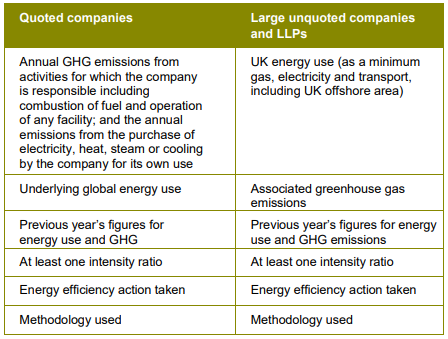
Page 27 of the current government guidance for SECR has a handy table showing the different requirements.
For more detail on the differences in reporting requirements, read our blogpost: SECR: What’s the difference between reporting requirements for quoted and unquoted companies?