


Retail and manufacturing businesses share some of the toughest decarbonisation challenges of any sector. They’re balancing energy-intensive operations, complex supply chains, evolving customer expectations and the need to keep investing, all while navigating rising costs and tightening environmental targets.
Against that backdrop, sustainability leaders are changing how they win support for new projects. The conversation is shifting away from carbon alone towards operational performance, resilience and long-term business value.
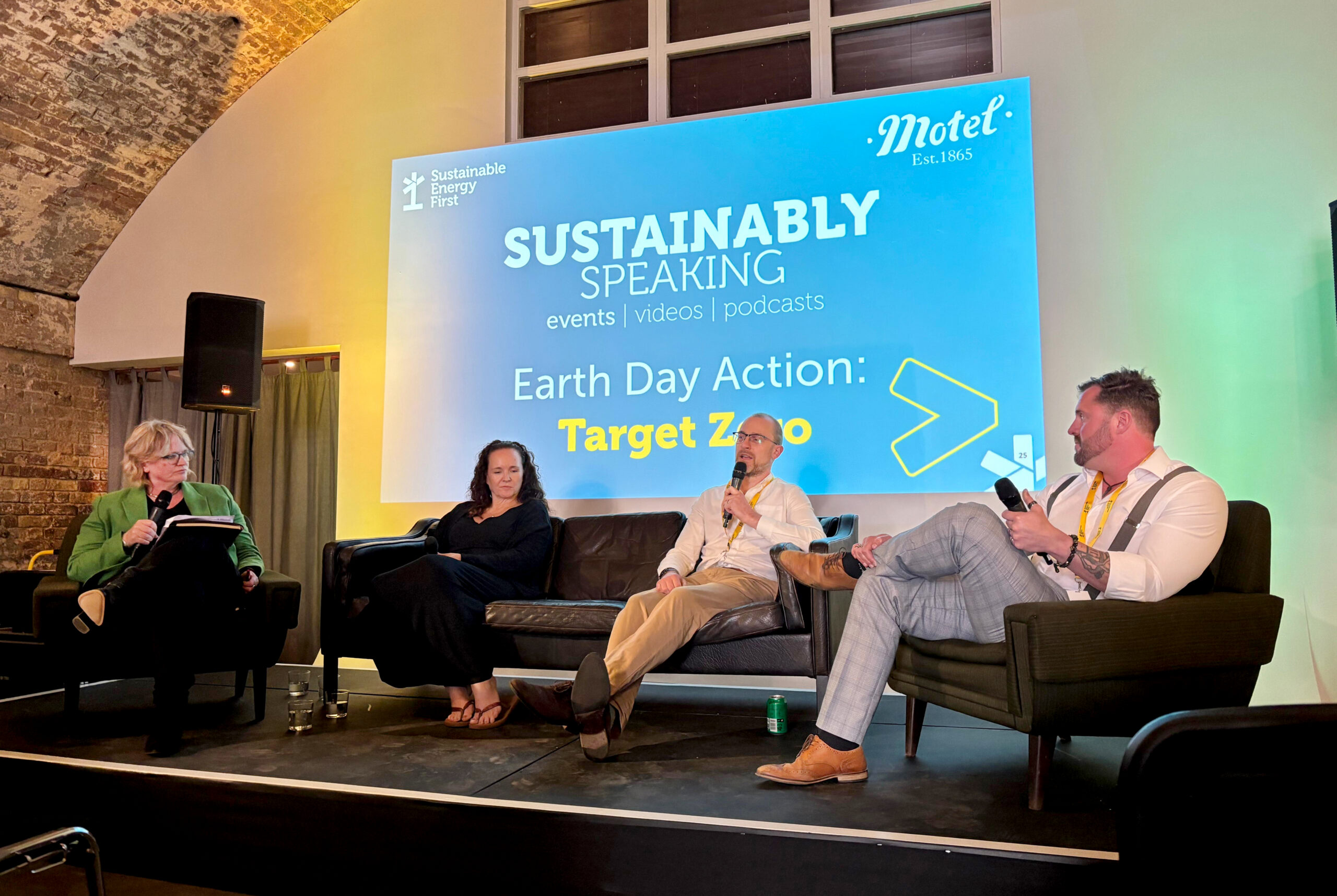
That theme ran throughout Sustainable Energy First’s Sustainably Speaking: Earth Day Action – Target Zero Retail and manufacturing panel, chaired by Joanna Watchman, Managing Director at Content Coms, with Luke Olly of Sainsbury’s Supermarket, Michael Moore of Roxane UK and Lisa Faratro of CPI Group.
Net zero commitments are only the beginning
For Lisa Faratro, making ambitious commitments is the straightforward part.
“As a business, we’ve signed up to a net zero pledge,” she explained. “For us, signing the pledges is the easy part. We try not to treat it as a tick-box exercise. It’s about the actions behind that and how we make the changes that are needed.”
Those actions don’t always deliver immediate financial returns, particularly in manufacturing, where replacing equipment can improve efficiency without solving bigger challenges such as removing gas from operations. That means taking a long-term view.
“It’s really about continuous improvement,” said Lisa. “How do you make your product faster? How do you make it better than your competitors’? How do you make it more environmentally friendly?”
Waiting until regulation forces change, she argued, rarely produces the best outcome.
“If you’re acting earlier because it’s the right thing to do, you usually discover additional business benefits aside from your ESG targets”
This idea – treating sustainability as part of continuous business improvement rather than a compliance exercise – became one of the defining messages of the discussion.
Operational realities shape sustainability progress
While long-term ambition matters, day-to-day operational constraints often dictate how quickly businesses can move. For bottled water manufacturer Roxane UK, energy is fundamental to production.
“We manufacture everything from PET resin right through to the finished product,” explained Michael Moore. “That’s a very energy-intensive process.”
That operational reality is also shaping Roxane UK’s approach to lightweighting plastic bottles. Reducing the amount of plastic used cuts material consumption, lowers embodied carbon and reduces manufacturing energy. But every improvement introduces new engineering challenges.
“Our 500ml bottles currently use 7.5-gram preforms, which are among the lightest on the market,” Michael explained. “We’re already looking at how we can go lower.”
The difficulty isn’t identifying the environmental benefit. It’s balancing that against product performance and customer expectations.
“Once a bottle starts to feel more like a water balloon than a bottle of water, consumers begin to pull away.”
The same balancing act applies to recycled materials. Roxane UK manufactures bottles using anything from 30% to 100% recycled PET depending on customer requirements, with customers balancing recycled content against cost considerations. Michael explained the technical challenges of maintaining consistent quality when recycled material naturally varies between batches. Rather than straightforward sustainability wins, these projects require operational excellence to balance environmental ambition with cost and functional requirements.
The strongest business cases tell a bigger story
Perhaps the clearest shift came when the discussion turned to investment.
For Luke Olly, sustainability projects at Sainsbury’s Supermarket rarely succeed because they’re labelled as sustainability projects.
“Sainsbury’s has always prided itself on the commitments it has made around ESG,” he said. “We recognise that we have a responsibility for all aspects of our environmental impact.”
But responsibility alone isn’t enough to secure investment.
“Very few investments are purely ESG projects,” he explained. “Many of the larger investments we make deliver benefits that are multifaceted.”
That’s where storytelling becomes just as important as technology.
“You have to tell the right story. You need to pull together all the different benefits that come with a particular project.”
Projects that improve efficiency, reduce costs, strengthen resilience, improve customer experience or reduce operational risk naturally become easier to support. Sustainability becomes one benefit among many, rather than the only justification.
Lisa agreed that the wider organisation needs to see those connections too.
“In our industry, ESG outcomes are often a by-product of savings being made elsewhere in the business.”
Ambition alone won’t solve infrastructure challenges
Even when organisations have compelling business cases, progress isn’t always entirely within their control.
Both Sainsbury’s and Roxane UK described grid capacity as an increasingly significant barrier to electrification.
As Sainsbury’s looks to replace mixed energy systems with electricity across stores, fleets and refrigeration, demand for grid capacity is increasing everywhere at once.
“The challenge is that everyone else is trying to do the same thing at the same time,” said Luke. “So access to supply, grid capacity and the practicalities of getting the infrastructure in place for the electrification of all our fleets are all things we need to consider.”
Michael shared an even more striking example.
Roxane UK secured funding for a planned 1.3MW solar installation, only to discover the local network could support just a fraction of that capacity.
“We’d like to do more,” he said. “The challenge is often that the system won’t let us.”
The business was unable to draw enough electricity from the grid to power its operations and had little choice but to install its own gas generation. It’s a reminder that, while businesses continue accelerating their own net zero plans, wider infrastructure must keep pace if those ambitions are to become reality.
Sustainability is becoming business strategy
Perhaps the most valuable takeaway from the discussion wasn’t about a particular technology or policy. It was about mindset.
The organisations making the greatest progress aren’t separating sustainability from commercial decision-making. They’re embedding it into investment decisions, operational improvement, product innovation and long-term resilience.
Luke offered one final piece of advice for anyone trying to build support for a new project, neatly capturing the wider conversation.
“My general ethos is: if it’s a good project, it will get funded. But first you have to prove that it’s a good project.”
As businesses continue navigating rising costs, evolving regulation and increasing pressure to decarbonise, that philosophy may prove just as important as any net zero target.
This panel discussion formed part of Sustainable Energy First’s Earth Day: Target Zero event in April 2026. We host several free events throughout the year to help businesses with their energy and carbon challenges. Get in touch via the form below to be notified of the next one.
If the content of this or any of our articles has interested you, please get in touch for a no-obligation chat with our industry-leading experts at Sustainable Energy First.