

This article is the second in a three-part series covering the panel discussions from Sustainable Energy First’s Pathway to Target Zero event. Our first article focused on decarbonising property, while the final instalment will explore insights on decarbonising transport.
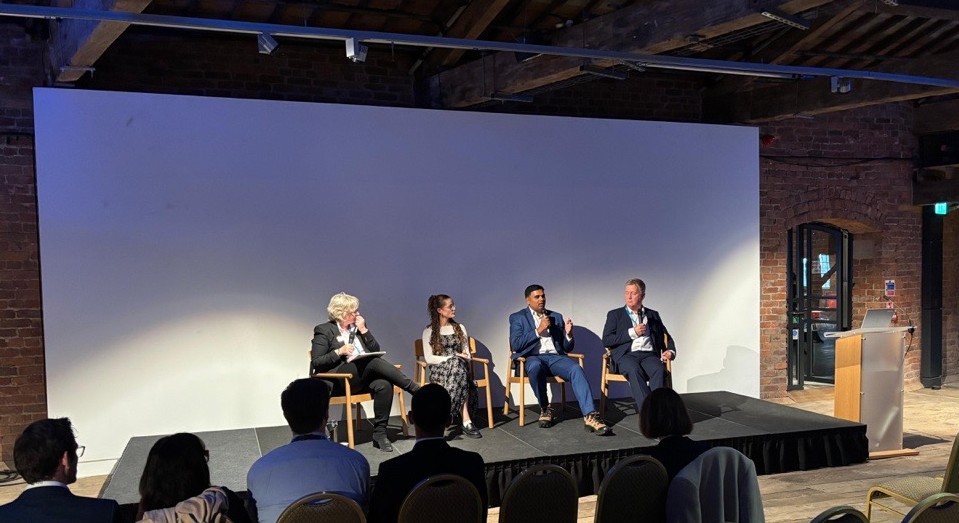
Building efficiency has never been more critical for retail and hospitality, sectors facing some of the toughest challenges on the path to net zero. At Sustainable Energy First’s recent Sustainably Speaking event, held in partnership with the Greater Manchester Chamber of Commerce, a panel of industry leaders came together to share their insights. They explored how data, technology, and collaboration can help businesses cut carbon without compromising customer experience.
Chaired by Joanna Watchman, Managing Director at Content Coms, the discussion featured Rosie Chapleo, Responsible Business Manager at Burger King UK; Mark Wignall, Account Manager at Sustainable Energy First; and Dr Prasanth Elavarthi, Sustainability and Digital Transformation Leader at Carrier Abound. Together, they unpacked the realities of decarbonising energy-intensive operations and shared practical solutions already making a difference.
Embedding sustainability at scale
For Rosie Chapleo, embedding sustainability across Burger King’s UK operations means tackling everything from packing and regenerative agriculture to energy use and employee behaviour.
Through the Burger King for Good programme, her team works on carbon reduction, packaging innovation, and supplier engagement. “My day-to-day is incredibly varied,” she said. “One day I’ll be talking about electricity, the next I’m sitting next to a lettuce supplier. It’s all about bringing the right stakeholders together to make things happen.”
As regulation grows, the Responsible Business team plays a crucial role in cascading compliance requirements across the organisation. “We used to rely on invoice data,” Chapleo explains. “Now we have half-hourly data. As we’ve moved towards net zero, the data requirement has escalated; understanding that data is key to identifying future carbon savings.”
Restaurant staff engagement also remains central. Campaigns such as ‘Save while you sleep’ and ‘Four-step prep’ focus on simple actions that save energy, like switching equipment off overnight and staging start-up times in the morning. Staff are also recognised through internal leaderboards and social-style updates celebrating top-performing restaurants.
Turning efficiency into opportunity
With years of experience supporting retail and hospitality clients, Mark Wignall knows how financial pressure and sustainability actions can clash. “Retail and hospitality have been really challenged on the cost front,” he said. “Reducing base costs through efficiency or on-site generation not only saves money but gives sustainability leads credibility to do more.”
Wignall compared today’s data-driven technology wave to the early LED lighting revolution: “At first, LED projects were expensive and uptake was low. But as adoption increased, costs fell, and it became standard practice. The same will happen with smart technologies if businesses invest early.”
He urged organisations to see sustainability as a route to operational resilience rather than a compliance exercise. “The goal is to introduce affordable technology that helps kitchens run efficiently without affecting the customer experience,” he explained.
“It’s about finding the right balance between efficiency and comfort.”
Predicting waste before it happens
As a digital transformation leader at Carrier Abound, Dr Prasanth Elavarthi focuses on how connected technology can help businesses proactively manage energy use. “We take data from our buildings, convert it to information, and then into actionable insights,” he explained. “Our algorithms can predict faults before alarms are triggered – a proactive rather than reactive approach.”
Carrier Abound’s AIoT (Artificial Intelligence + Internet of Things) connects to existing Building Management Systems or uses standalone sensors to monitor refrigeration, lighting, HVAC and kitchen assets. Insights are delivered via mobile dashboards or global command centres operating 24/7, enabling remote optimization and early intervention.
Elavarthi gave practical examples of how small changes could add up:
- Turning off drinks refrigeration overnight without affecting food safety
- Detecting open fridge doors or overstocking via temperature analytics
- Adjusting HVAC schedules based on occupancy and outdoor temperatures
“Every customer is different,” he said, “but data helps us maintain comfort, meet compliance, and save energy simultaneously.”
Across all three speakers, one message came through clearly: achieving net zero in retail and hospitality depends on the intersection of data, people, and technology.
Continue the conversation on Earth Day.
Our next Sustainably Speaking: Target Zero event takes place on Wednesday 22 April in London. Designed to help decision-makers progress their organisation’s net zero goals, the event includes expert panel discussions, group fireside sessions and a chance to connect with clean technology partners.
Sign up to be the first to hear event details, speakers, and how to get involved.
For more insight into how you can cut costs and reduce carbon emissions in your own building, get in touch with Sustainable Energy First via the form below.