



With energy price volatility continuing to buffet the hospitality sector, operational resilience has moved firmly to the top of the business agenda. Against this backdrop, Sustainable Energy First brought hospitality leaders together for a panel discussion at Sustainably Speaking to explore the industry’s most pressing energy challenges.
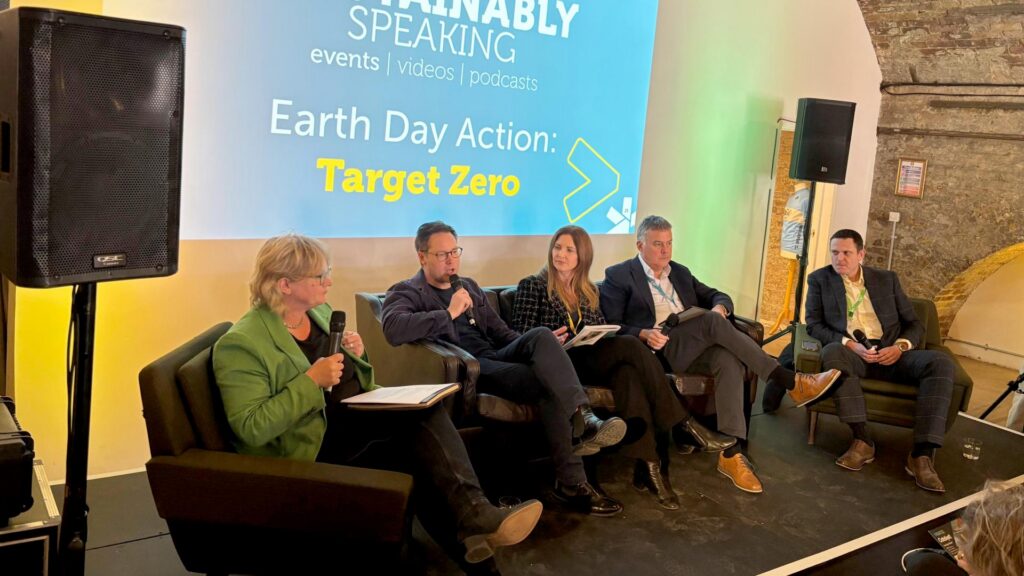
The panel represented a rare opportunity to bring together influential voices from across the hospitality sector – each offering generous, practical insights on navigating uncertainty and future proofing energy supply.
Chaired by Joanna Watchman, Managing Director of Content Coms, the panel included Tim Doubleday of Burger King UK, Jennifer Guilfoyle of Maybourne, Allen Simpson of UKHospitality, and James Hall of Evolve Energy.
Setting the scene, Allen Simpson, Chief Executive Officer at UKHospitality highlighted the scale of the challenge, noting that “hospitality is exposed to three things… property, people, and energy.” Here are the top five take-home tips from the day’s panel, with resilience at the heart of the conversation:
1. Build your 100% renewable strategy from multiple sources
As the Chief Legal Officer and Company Secretary for luxury hotel group Maybourne (whose portfolio includes some of London’s most iconic hotels, such as Claridge’s, The Connaught and The Berkeley), Jennifer Guilfoyle must juggle superb customer experience with an energy procurement strategy worthy of the hotel’s prestigious name. Guilfoyle says that means sourcing energy in a more sustainable way, so that “when you come and stay in our beautiful properties, you also feel like you’re doing your best.”
In practice, this translates into a diversified renewable energy strategy for Maybourne. While on-site generation wasn’t feasible for its central London properties, the group was able to secure renewable electricity through a Corporate Power Purchase Agreement (CPPA), a long term-agreement that supports renewable energy generation projects in exchange for fixed-price energy. However, Guilfoyle explained that relying on a single renewable energy source did not feel resilient enough on its own.
“And so, as part of this process, it did occur to me, if we don’t have batteries and the sun’s not shining, where’s my electricity coming from? …I want to be able to say, we’ve got 100% renewable electricity. So, then we got a similar deal up in Yorkshire.”
By implementing a multi-pronged renewable energy strategy alongside a backup tariff, the hotels will be able to operate from 100% renewable energy.
“So, when the sun’s not shining, hopefully the wind’s blowing and then we’re also on a backup tariff, which means that we’ll get it [energy] from a 3rd party.”
2. Resilience doesn’t always require a long-term commitment
Often, one of the barriers for businesses interested in CPPAs is the 10-to-15-year investment required, says Tim Doubleday, Chief Financial Officer of Burger King UK. Particularly in today’s volatile energy market, investors are hesitant to engage in such long commitments.
“What we’re really looking at,” says Doubleday, “is risk versus reward of energy price change over time.”
Through collaboration with Sustainable Energy First and Evolve Energy, Burger King UK was able to engage with smaller-scale renewable projects that better aligned with investor expectations and operational flexibility. By securing a CPPA, up to a third of Burger King UK’s energy could come from renewable energy sources, while also underpinning the viability of the generator’s renewable energy site.
“On a 15-year deal, you have no idea what’s going to happen that far out. Whereas if you have a 5-year deal, you’re protected from the kind of issues we’re currently seeing with the Strait of Hormuz.”
With shorter deals, investors have a clear sightline to deliver stability while also still remaining flexible. Some businesses are now choosing shorter energy deals to maintain both agility and security from an energy and cost perspective.
“From a business perspective, you can manage what you know. So, if you know your energy cost base you can build it into your plans going forward,” says Doubleday.
So, shorter-term CPPAs may be on the rise in the future, particularly in a time when energy resilience is vital now more than ever.
3. Cost savings and sustainability now go hand in hand
While sustainability has often been framed as a reputational benefit, several panelists agreed that the conversation has shifted significantly in recent years. Increasingly, businesses are pursuing renewable energy strategies not just because they are greener, but because they also make commercial sense.
Allen Simpson, Chief Executive Officer at UK Hospitality noted that hospitality businesses are particularly vulnerable to volatility because of already tight operating markets.
“Hospitality is exposed to three things,” says Simpson. “Property, people, and energy.”
With rising input costs and increasing consumer sensitivity to pricing, the panel agreed that resilience and cost certainty are now becoming just as important as sustainability credentials themselves.
Tim Doubleday echoed this statement, pointing out that renewable procurement models can also reduce non-commodity costs and improve overall pricing visibility.
Referring to Burger King UK’s renewable procurement strategy, Doubleday said, “The fact it’s green was the great by-product.”
“Coupled with the resilience, the fixed-price nature, and the reduction in non-commodity costs, it eventually makes it a bit of a no-brainer.”
4. Smaller operators now have access to better energy solutions
Historically, CPPAs have often been associated with large corporates capable of committing to sizeable, long-term energy contracts. But panelists highlighted that this is beginning to change.
According to James Hall, Chief Operating Officer at Evolve Energy, new consortium-style approaches are making renewable procurement more accessible to smaller operators that may previously have been locked out of the market.
“Typically, we find that energy is always in the top three in terms of overhead costs,” says Hall.
“In many cases, it’s second only to employee wages. So, it’s a very, very important component.”
As a result, more collaborative procurement models are emerging to help businesses pool demand and access renewable energy at a scale that wouldn’t be possible individually. One example is the Sustainable Energy Consortium (SEC), developed by Sustainable Energy First, which brings organisations together to connect with a diversified mix of UK renewable generation across wind, solar and hydro.
By aggregating demand, these models enable businesses to access renewable supply with greater flexibility, often through shorter-term, fixed structures that improve both price visibility and resilience. They can also support progress against Scope 2 emissions targets, without requiring the scale typically associated with traditional CPPAs.
Tim Doubleday explained how consortium-style arrangements helped bridge the gap for Burger King UK as it scaled its energy strategy.
“We weren’t big enough to do our own power purchase agreements,” says Doubleday. “So, we were working with SE First as part of the consortium, and then later moved into our own PPAs.”
The result is that renewable procurement and energy resilience strategies are no longer reserved solely for the very largest operators, with smaller businesses now able to take a more active role in shaping their energy supply.
5. The future belongs to flexible energy portfolios
Across the panel discussion, one theme emerged repeatedly: resilience increasingly depends on diversification.
Simpson argues that hospitality businesses are now facing many of the energy pressures traditionally associated with manufacturing and other energy-intensive sectors.
“Anybody who has to bring food into a business knows that a massive amount of their inputs are incredibly exposed to the cost of energy,” he says.
By combining renewable technologies, including wind, solar, hydro, and other sources, businesses can reduce exposure to individual market or weather-related risks while improving long-term energy security.
For hospitality businesses operating in an increasingly uncertain landscape, flexible and diversified strategies may prove critical to managing both future costs and operational resilience.
Curious about how your organisation could build a more resilient and flexible energy strategy? Sustainable Energy First works with hospitality businesses to explore practical routes into renewable procurement. Get in touch with one of our experts for a no-obligations chat.