

This article concludes our three-part series from the latest Sustainably Speaking event, following previous discussions on the property and retail and hospitality sectors.
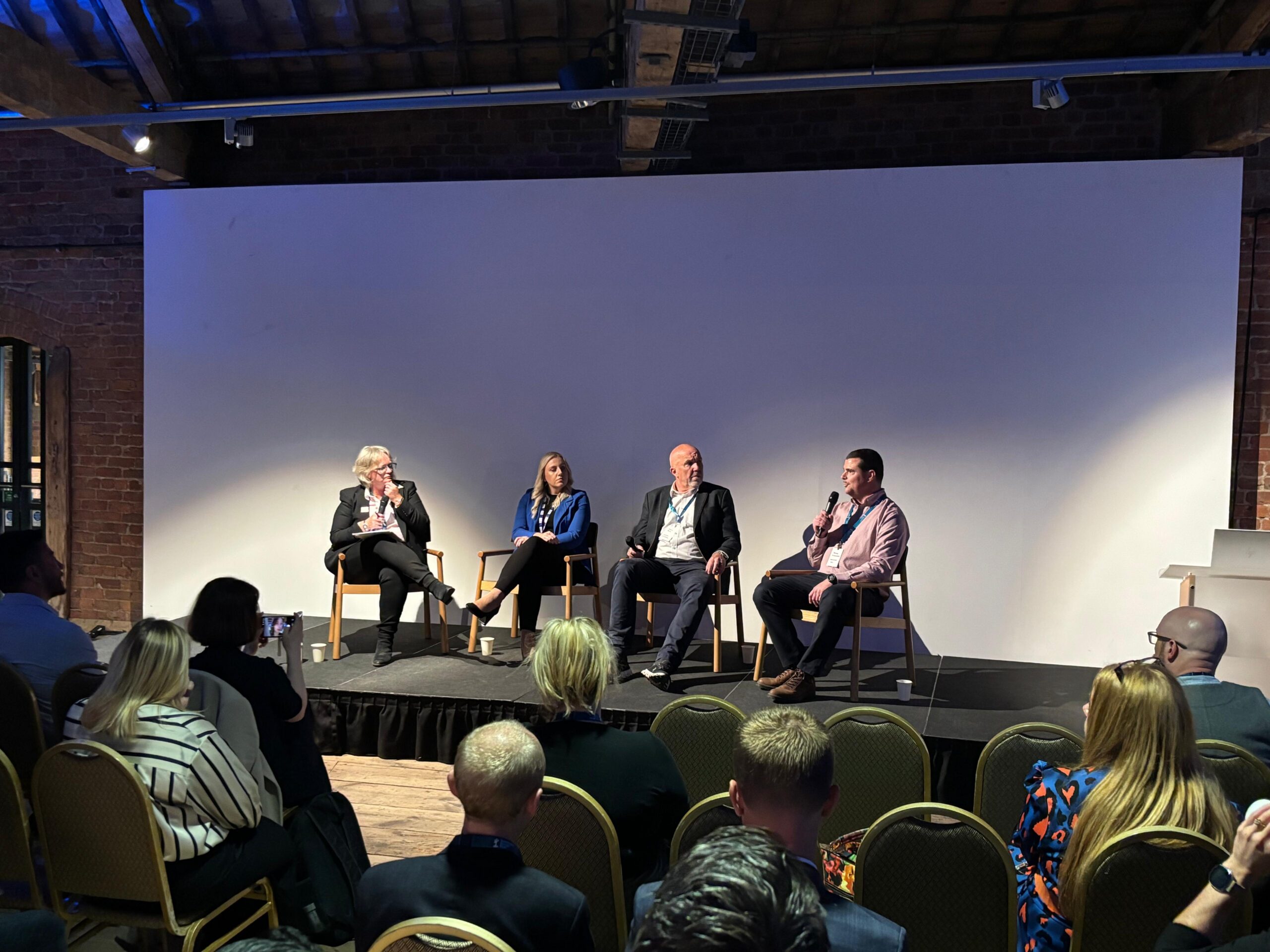
Transport remains one of the UK’s biggest decarbonisation challenges, responsible for around a third of total greenhouse gas emissions, according to DESNZ. At the latest Sustainably Speaking event, hosted by Sustainable Energy First in partnership with the Greater Manchester Chamber of Commerce, a panel of experts explored how electrification, technology, and innovation are reshaping the road to net zero transport.
Chaired by Joanna Watchman, Managing Director of Content Coms, the session featured Wayne Jones OBE, Improbus Consultancy and Director of the Greater Manchester Chamber of Commerce; Fiona Price, Head of Business Development at Stark Charge and Zero; and Jimmy Richardson, Carbon Manager for Network Rail’s Transpennine Route Upgrade (TRU). Together, they examined the environmental, social, and economic dimensions of electrifying UK transport infrastructure.
Future-proofing the UK’s railways
The Transpennine Route Upgrade (TRU) is a major programme of railway improvements stretching from Manchester Victoria to York. It’s focus on electrification will, according to early modelling, save around 3.2 million tonnes of CO2 equivalent over its lifetime.
But, as Jimmy Richardson explained, the challenge goes beyond operations, “It’s a significant step forward from an operational perspective, but there are emissions associated with construction, and we have carbon-reduction targets linked to those activities as well.”
Richardson’s team has built a framework to assess, monitor, and report whole-life carbon from construction. “Some of the most positive interventions I’ve seen on the programme have been around reuse,” he said, with track panels being taken off one project and re-used for another. The benefit? Reduced cost as well as reduced embodied carbon.
Leadership has a key role to play in these actions, Richardson says. “Every four weeks, we report our progress to the senior leadership team and the executive board. If I have any issues, I can speak directly to the chief engineer or the programme director to help unblock them.”
Electric vehicles charging ahead
As the UK aims to accelerate its shift to electric vehicles, Fiona Price highlighted the importance of reliable, integrated charging infrastructure: “We’re an independent Distribution Network Operator and an independent Connection Provider, so we can do full grid connections. If we’re going to dig up the road, we’ve got a company called Starlecs handling everything through to data collection.”
This full-service model eliminates the confusion many customers face when multiple contractors are involved.
“When we go and visit customers, it’s often because they’ve had a bad news story with another Connection Provider – there were just too many contractors. By keeping it under one roof, we make the process far more efficient.”
Price also noted that smart charging and flexible energy management will become increasingly valuable as the EV market expands.
Freight, flexibility, and the road to net zero
For Wayne Jones, electrification is as much a leadership opportunity as a technical one. Speaking from both a business and a regional-growth perspective, he underlined the importance of collaboration across government, industry, and local expertise.
Responding to a discussion about energy-system flexibility, he acknowledged its potential in rail operations.
“I don’t think we’d be in a position to encourage passengers to be travelling overnight to help manage that kind of grid load. But long-term, the Transpennine Route Upgrade is looking at freight capacity. Freight operating companies could transition to bi-modal or similar rolling-stock technology, and evening freight services would be a way of maximising that opportunity. That’s part of the programme’s scope.”
Jones also pointed to the economic benefits electrification brings to Greater Manchester and the wider region, helping attract investment and develop new skills.
From national rail upgrades to local charging networks, the panel agreed that the journey to net zero transport relies on connecting infrastructure, innovation, and people.
This article concludes our three-part series from the latest Sustainably Speaking event, following previous discussions on the property and retail and hospitality sectors.
Continue the conversation on Earth Day.
Our next Sustainably Speaking: Target Zero event takes place on Wednesday 22 April in London. Designed to help decision-makers progress their organisation’s net zero goals, the event includes expert panel discussions, group fireside sessions and a chance to connect with clean technology partners.
Sign up to be the first to hear event details, speakers, and how to get involved.
For more insight into how you can cut costs and reduce carbon emissions in your own building, get in touch with Sustainable Energy First via the form below.